.png)
 10 hours ago
5
10 hours ago
5
The 2026 World Cup will be the biggest, longest and most expensive. It will also feature a hefty number of rule changes. New responsibilities for video assistant referees, new red card offences and a number of initiatives to speed up the game will be put into effect. Here are the rule changes for the US, Canada and Mexico and why they have been implemented.
VAR to check corners and
second yellow cards
Although fans are increasingly united in their dislike of video refereeing, Fifa is ready to hug it tighter and has expanded the VAR protocol. First, video officials will be expected to check every decision that results in a corner. According to guidance issued by the law-making body, the International Football Association Board (Ifab), the VAR should intervene only if they can do so quickly, though there is no defined time limit. VAR will also be expected to assess decisions that lead to the award of a second yellow card and thus a sending-off (currently, they look only at straight red cards). Some figures within Ifab are hesitant to extend VAR’s brief (the reviewing of corners has been made optional and the Premier League appears ready to reject it) but Fifa is concerned about a wrong decision affecting a high‑profile match. The original VAR protocol was developed with the aim of eliminating serious incidents missed by match officials.
VAR also to check for fouls before set pieces
In an unexpected development, less than a fortnight before the World Cup starts, Ifab announced another change to the VAR protocol. Labelled a “clarification”, this adaptation will extend the window for assessing goals, penalties or sendings-off that follow the taking of a set piece. Video referees will be encouraged to check for any offence before the set piece had been taken (but while play was stopped), if the incident is deemed to have had a “direct impact” on the outcome. This development has been widely interpreted as a tool to tackle grappling in the box before corners and free-kicks, and a missed foul in the buildup to England’s opener in a recent friendly against Uruguay is an example of the type of infraction being looked for.
Red cards for covering mouths and leaving the field
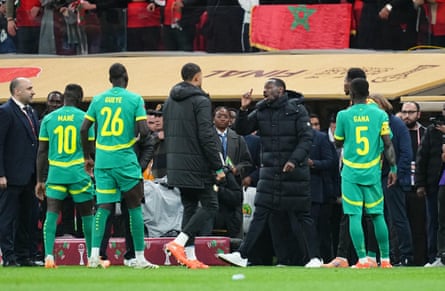
Two notorious incidents this year have led directly to new red card offences. The first follows the decision by the Senegal coach, Pape Thiaw, and some of his players to walk off the field during the Africa Cup of Nations final in protest at a penalty being awarded against them. Now any player or official who “leaves the field of play in protest at a referee’s decision” can be given a red card. The same sanction will apply to players who cover their mouths “in a confrontational situation”. This change has been widely trailed after the Benfica midfielder Gianluca Prestianni hid his mouth under his shirt before confronting Vinícius Júnior during a Champions League tie. Real Madrid claimed the abuse was racist but the player admitted to and was banned for homophobic remarks. In an unusual intervention, the Fifa president, Gianni Infantino, personally called for such actions to result in a sending‑off and this rule, which has been made optional, will be applied at the World Cup.
Measures to stop ‘tactical timeouts’
One growing source of frustration within the game is the persistence of tactical timeouts, where the treatment of an apparent injury is used as a chance for coaches to relay instructions to players. They are seen as the exploitation of a loophole and an unnecessary interruption to play – a focus for lawmakers – so officials will clamp down on this behaviour at the World Cup. Outfield players will be expected to leave the field for treatment (as before) but then to stay off the field for 60 seconds before returning once treatment is complete. Goalkeepers – the prime culprits in tactical timeouts – will continue to be treated on the field, but referees are expected to adopt a measure from the National Women’s Soccer League (NWSL), which dictates that while treatment continues all other players must retreat to the centre circle and not go to their coach’s technical area.
The successful introduction of referee countdowns to help speed up goal-kicks has meant the measure will be expanded at the World Cup to include throw-ins. In both cases referees can, with their hand, signal a five-second countdown to dawdling players. If the count reaches zero then the throw-in will be granted to the opposition or, in the case of goal‑kicks, a corner will be awarded to opponents instead.
A further, and final, rule tweak requires that any player being substituted must leave the field of play within 10 seconds of their number being raised. If they take longer, any replacement player will be kept off the field for a further minute.