.png)
 11 hours ago
3
11 hours ago
3
When Pakistan last arrived in England for a Test tour, in the Covid-bubble summer of 2020, they brought along the future. Shaheen Shah Afridi, 20, was the towering left-armer set for world domination. Naseem Shah, 17, was armed with a Test hat-trick and a velvety action, the right arm whipping the ball down at 90mph. They looked the part, carrying the grand traditions of Pakistani fast bowling, a reminder of the golden names that came before: Imran Khan, Wasim Akram, Waqar Younis.
Mohammad Abbas joined Shaheen and Naseem in that seam attack as the odd man out, 30 and medium-fast, a first-class specialist, the accountant in a movie-star lineup. But six years on Abbas is the great survivor, the only one of that triumvirate named in Pakistan’s squad for their three-Test series in England starting next week. Shaheen and Naseem have suffered for their art – the former has struggled with the red ball since a knee injury in 2022 – and fallen victim to the tragicomic mismanagement of the Pakistan Cricket Board.
Abbas is well known to English audiences. Now 36, he has an exceptional record in the County Championship, taking 302 wickets at 20.64 for Leicestershire, Hampshire, Nottinghamshire and Derbyshire, and not much has changed at Test level. Making the ball dance off the seam, he has 118 wickets for Pakistan at a staggering average of 22.38.
Nottinghamshire’s Peter Moores and Derbyshire’s Mickey Arthur are two coaches who have seen the mastery up close. “He’s got really long fingers,” says Moores. “His gift is in his wrist and in his right hand, really, that ability to control how the seam comes out and the slight variations on the ball.” Arthur, who also coached Abbas while in charge of Pakistan, adds: “He’s almost like a surgeon in the way he works with that seam. He can get it nipping in, nipping out. And he bowls a really good wobble ball as well, so he’s got it all.”
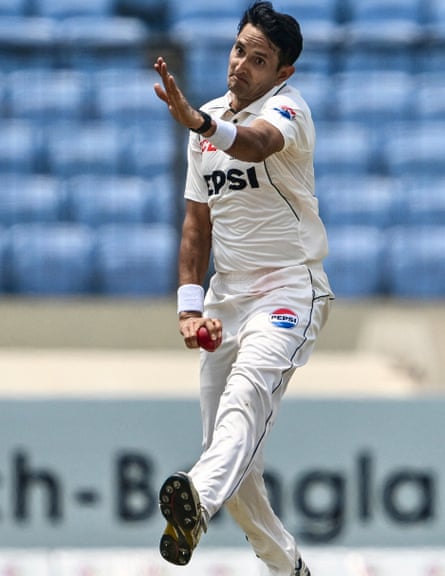
Moores describes a bowler who can adapt to any surface while Arthur raves about his control. Yet Pakistan have still found ways to ignore him; Abbas has only 30 caps across a nine-year Test career. Operating in the mid-70s (mph), his speeds look out of place in the international game. “But what he has done is he gets people out and that’s the job,” says Moores. “It’s like batters who aren’t as easy on the eye but score runs. And those players are so valuable. You’ve just got to make sure you treat them with the respect they deserve because his record tells you he gets wickets and he never lets you down.”
Nonetheless, Abbas’s reward for taking eight wickets in Pakistan’s defeat in the first Test against West Indies in July was to be dropped for the second. The spinners took over in Port of Spain, with Sajid Khan’s off-breaks delivering eight wickets to level the two-match series, and the slow stuff has brought Pakistan their doses of joy in the past couple of years. Their last Test series victory was a 2-1 triumph against England in October 2024, built on spinning tracks in Multan and Rawalpindi after a thumping defeat in the opening match. Shaheen and Naseem were discarded from the XI; in came Sajid and the left-arm tweak of Noman Ali, the pair combining for 39 wickets in two Tests. It set the template for how Pakistan have since played at home.
Jason Gillespie was Pakistan’s head coach during the series win against England, having taken up the role that April – but was against the mid-series switch to preparing massive turners.

“It was very shortsighted,” says the former Australia quick. “When I arrived, [the PCB] wanted to have fast bowlers. And they wanted to develop their fast bowlers. They wanted to play on surfaces that allowed for fast bowlers to thrive. And then a couple of Test matches were lost. New selectors were brought in and they decided that we’d play on used pitches and spinning tracks. It went against the long-term plan of developing bowlers, particularly fast bowlers.” Gillespie was stripped of his say in selection and resigned two months later as his relationship with the PCB deteriorated further.
A year and a half on Pakistan have arrived in England with a seam attack that does little at home, and without a quick who’ll really get the blood pumping. Ubaid Shah, Naseem’s 20-year-old brother, has been called in to crank it up but the hosts should beat them on the speed guns this summer. Babar Azam’s side will have to rely on the cliches – line and length, stay disciplined – while Sajid twirls away in this dreadfully dry summer. Mohammad Ali is another seamer who has played county cricket this year and if Pakistan have done their research they’ll have Mohammad Rizwan up to the stumps, suffocating England’s batters as Abbas settles into his groove. All Pakistan have to do is make sure they pick him.