.png)
 5 hours ago
6
5 hours ago
6
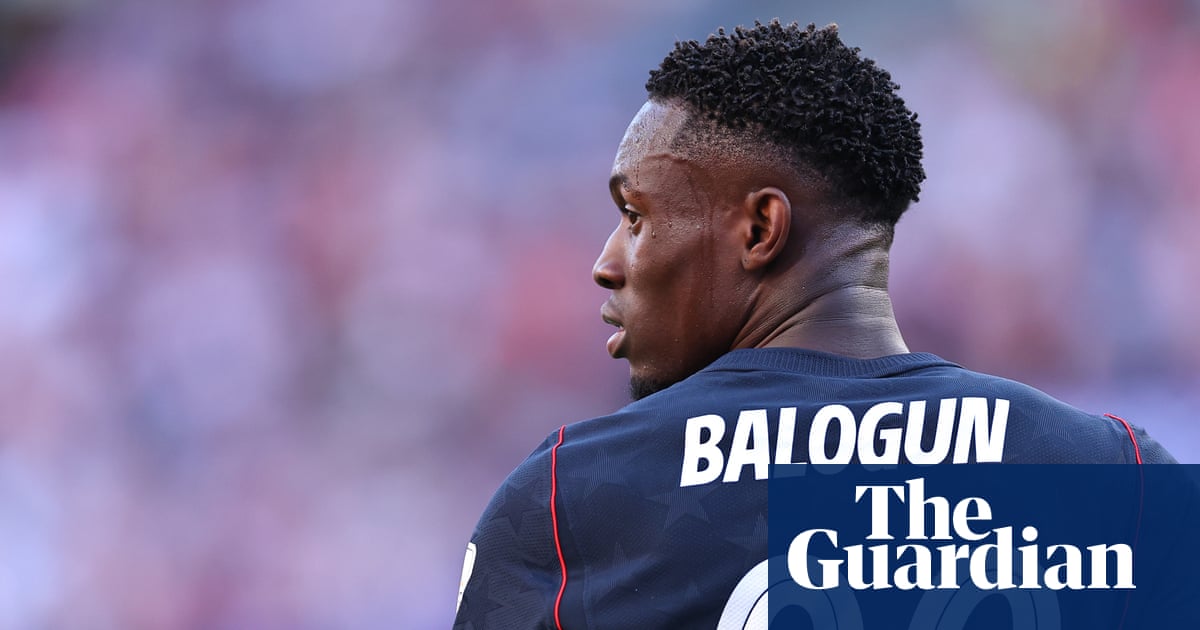
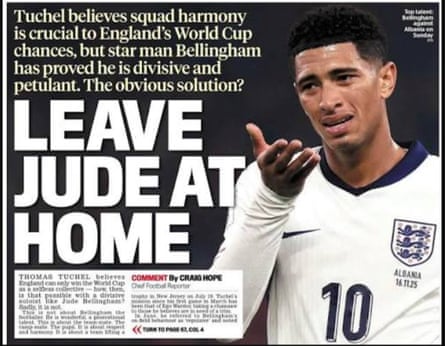
Months before the World Cup, the familiar chorus of antipathy that had followed Jude Bellingham almost since his emergence on the international stage grew louder. A number of writers, pundits and former professionals questioned whether one of England’s most gifted footballers might prove detrimental to the squad’s harmony. The clearest expression of these arguments appeared in a Daily Mail article in November 2025 beneath one of the most ignominious headlines in English footballing history: “Leave Jude at home.”
Amid a wave of criticism directed at Bellingham, Ian Wright felt compelled to defend him on an episode of Stick to Football. Once clipped, his remarks spread rapidly across football’s social media ecosystem and beyond, both because of Wright’s candour, and for placing the hostility directed at Bellingham within a historical tradition of policing Black men’s behaviour. “Someone like Jude, for some reason, frightens these people,” Wright said, before adding: “It’s something you’re taught as a Black man … to keep your head down and be, for want of a better word, a humble fucking slave.”
There are, of course, perceived footballing transgressions that have set Bellingham on an unavoidable collision course with English football’s established order. His first “mistake” was to see Birmingham City retire his shirt number before he had turned 18. His second was to reject England’s elite clubs in favour of Borussia Dortmund. Real Madrid then paid an initial €103m (£88m) for him, entrusting him with the No 5 shirt once worn by Zinedine Zidane. Throughout, Bellingham has appeared almost entirely devoid of the insecurity that has consumed so many English footballers abroad. But Bellingham’s success in Madrid has rarely been treated as a source of English pride; rather, it is read as an implicit challenge to the Premier League’s claim to occupy football’s summit. He is beamed back to us already belonging to the wider world.
While these factors partly explain the hostility Bellingham provokes, Wright’s account of why he is read this way is ultimately more convincing. There is a cultural specificity to Bellingham’s comportment that, while immediately familiar to many Black Britons, is read elsewhere as an aggravating factor. As a child, my aunt would insist I walk with my shoulders back, and my head held high, so that I might project an image of myself others might else refuse to imagine. As an adult, I learned this advice was a repetition of words she had first spoken to herself after arriving from the Caribbean into a society that told her she did not belong.
We don’t know whether Bellingham received similar instruction – perhaps we are simply witnessing the unshakeable self-belief of one of the world’s finest footballers – yet given how common this form of cultural inheritance is among Black families, it is entirely plausible that he did.
English football repeatedly searches the emotional terrain of its history for meaning, obsessing over its solitary triumph and the countless moments of “almost”. It returns, too, to the players in whom it has recognised itself: Bryan Robson, David Beckham, Paul Gascoigne. Perhaps none has proved as enduring as the last of those. Jack Grealish was briefly cast as his spiritual successor, and before Euro 2020, Phil Foden dyed his hair the same peroxide hue Gascoigne wore at Euro 96, consciously placing himself within that same lineage.
Bellingham exposes the limits of this process of recognition.
England has long capped exceptional Black players. Yet whether through outright social refusal – as Paul Gilroy observed in “Race”, Sport and British Society, John Barnes’s exclusion from British sporting greatness became “a matter of national honour” for some England fans and notable pundits – the preference for Alan Shearer that consigned Andrew Cole to his shadow, or the sustained hostility directed at Raheem Sterling, the national side has until now never felt able to declare its defining figure a Black one. But in producing the greatest individual England tournament performances of recent memory, Bellingham has become tactically indispensable and the emotional and symbolic focal point of the national team.
The spontaneous chorus of Hey Jude that now greets England victories offers its own evidence of this: a Black footballer whose name, features and heritage are no barrier to instinctive English identification.
after newsletter promotion
Each successive generation of Black people born and raised in England is shaped by the country as much as it reshapes England in return. While it would be irresponsible to insist that one footballer can resolve the tensions that so often place Blackness and Englishness in supposed opposition, Bellingham clearly sees no contradiction between the two. Perhaps his greatest significance lies in showing those who come after him that they need see none either.
-
Calum Jacobs is the author of A New Formation: How Black Footballers Shaped the Modern Game and the founder of CARICOM magazine