.png)
 2 hours ago
1
2 hours ago
1

 French Ministry of Culture
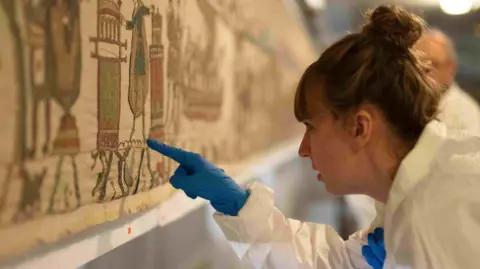
The artwork was meticulously inspected before its removal
The 950-year-old Bayeux Tapestry will be as safe "as a baby" when it makes its unprecedented journey to London next month, according to French officials.
The tapestry will be leaving Bayeux for only the third time in its history before being put on display for nine months at the British Museum.
Serious reservations about the journey have been raised by many in France's art world, who say the tapestry is too fragile and too important to move.
But after two dry-runs with facsimiles, the culture ministry in Paris is confident the technical difficulties have been overcome.
"I am extremely serene," said Delphine Christophe, the ministry's head of heritage and architecture.
"Nothing has been left to chance."
To preserve it from possible damage, the 70m (230ft) tapestry will be placed in a kind of double crate – a case inside a shell.
Last September, 90 people were required to lift the artefact from its display in Bayeux and place it on a folding stand. This is currently at an undisclosed location somewhere in or near Bayeux.
For the journey to London, the stand – which concertinas down into a relatively small space – will be put into an aluminium crate that regulates temperature and humidity.
That crate will then be housed in an outer cage, with 12 metal springs acting as shock-absorbers above and below.
The ensemble will be placed on a lorry which then travels by road and the railway shuttle under the Channel for the 560km (348 mile) journey.
"The idea is that the vertical shocks which will occur are transformed into horizontal shocks, causing the inner crate to rock to and fro like a baby in a cradle," said Cecilia Gauvin, an expert in art conservation.
 French Ministry of Culture
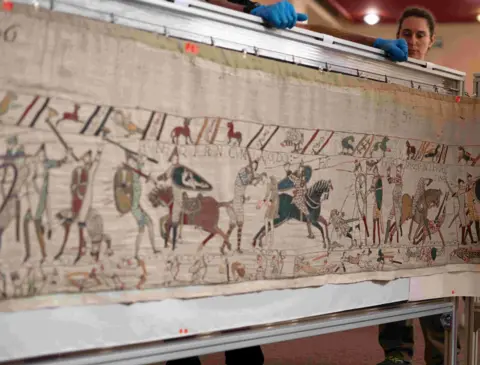
The Bayeux Tapestry depicts the story of the Norman conquest of England in 1066
The two dummy-runs to London – in February and April – showed that shocks are absorbed to a measurement of 96% – reduced, in other words, to the level artworks regularly experience simply by being on display.
"Don't forget an artwork receives vibrations merely from the footsteps of all the visitors to a museum," said Kerstin Kracht, an expert in vibration reduction.
The team observed that English roads contain more bumps and potholes than their French equivalents – but not so many as to upset calculations.
The date of the transport is being kept secret for security reasons, but it will be sometime in July.
Once at the British Museum, the tapestry will be removed with the same care and manpower as was required for its storage, before being laid out – flat, not vertically – for display.
Some specialists – such as Didier Rykner, leading French arts writer – remain sceptical.
"What happens if there is a problem in the tunnel and the lorry gets stuck there? These technical reports they have produced are meaningless – they're just there to justify the political decision that's already been taken," he said.
 French Ministry of Culture
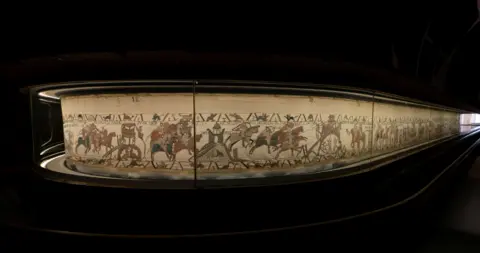
The tapestry on display before its restoration and removal
But the reality is there is no longer any serious obstacle to one of the most important journeys of a work of art ever made.
The Bayeux Tapestry – which is actually an embroidery on linen – was created in the years following Duke William of Normandy's conquest of England in 1066, and recounts in picture form events leading up to the Battle of Hastings.
It was kept in Bayeux Cathedral for centuries, and not re-discovered until the 1700s. In 1803, Napoleon brought it to Paris as a propaganda tool for his planned invasion of England, and it was moved a second time to Paris in World War Two.
The loan of the tapestry – requested many times over the years by the UK government – was announced by French President Emmanuel Macron in 2025. The gesture has an explicit political aim of cementing Franco-British ties at a time of growing instability in world affairs.
As a quid pro quo, the UK is sending major artworks for display in Normandy museums, including the 12th century Lewis chess-set and the Anglo-Saxon treasures from the Sutton Hoo burial mound.
2027 is being celebrated in Normandy as the thousandth year since the birth of William the Conqueror.