.png)
 1 month ago
101
1 month ago
101

 Getty Images
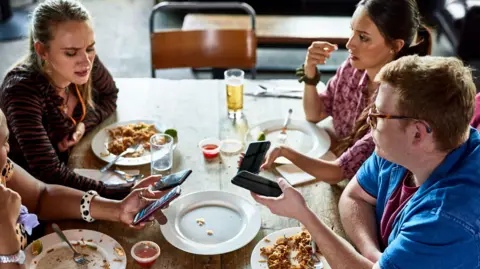
One friend orders two cocktails. Another "just wants to try" that £16 truffle arancini starter. But you stuck religiously to tap water. So when the waiter places the card reader on the table at the end of the night, you are facing a social minefield.
Even if you are sober enough to manage the mental arithmetic, you will be hard-pushed to overrule the jolly friend who shouts: "let's just divide it equally!"
"When we eat out, we always just split the bill," says Ella, a communications assistant from Leeds.
The 23-year-old says she never suggests to her friends they all just pay for what they've ordered as "it just feels awkward".
Ella earns over £30,000 but some of her friends earn more and she finds it hard to say no if they want to go somewhere a bit fancy that she can't really afford. Instead she matches her order with theirs so she isn't left feeling short-changed.
It is worse when it's a big ticket item like a holiday.
When that happens, rather than tell her friends how she feels, she scrabbles around for extra money.
"I'm probably on the phone to my mother in secret asking to borrow that extra bit of cash," she says.
 Ella
Ella
Talking about bill-splitting is just too awkward, says 23-year-old Ella
Her reluctance to speak up reflects a wider trend.
Research from the Money and Pensions Service (MaPS) in 2025 found that only four in 10 adults do feel comfortable talking to friends about money, with women significantly less likely to feel okay discussing finances with friends (39%) compared to men (50%).
Ella says money is almost never discussed within her friendship group. They have booked a four-night beach holiday costing around £680 each for flights and accommodation and they are using a bill-splitting app to log expenses before balancing everything at the end.
"We never really consider if something is affordable or not," she says. "We all pay the same, no matter your salary."
Rolling into the restaurant and announcing you won't be footing your friends' booze bill can make you feel like a bit of a buzzkill if others are planning to live it up. But experts suggest that is best way to tackle the problem: be open from the start.
Laura Pomfret, chief executive of women's finance community Financielle, says people worry that speaking up will ruin the atmosphere. But friends often respond positively if you are honest about your financial situation, she says.
"If you know you have a limit on what you can afford, say it at the beginning rather than sitting through the meal hoping someone else suggests paying separately," she advises.
- Decide beforehand: If an event is outside your budget, save for it in advance or skip it altogether
- Give a reason: You don't have to say you can't afford it. Say you are saving for something else, a holiday or investing.
- Remember, spending is personal: Even if your friend can afford a £100 meal they may not wish to spend their money that way
Chloe, 31, who runs a tech startup and earns around £80,000, says she and her friends are very open about salaries and what they can afford, partly because they have been through tough times together.
"We talk about money all the time - pay rises, investments, whether we can afford something."
"We'll say, 'I can't afford that this month - can we do it next month instead?' It's about breaking down that wall of shame."
 Chloe
Chloe
Chloe and her best friend have always been open with each other about money
Now she is on a higher income she is happy to cover for the others sometimes.
"I live in London and when friends visit who are between jobs, they might pay for the train ticket and then I'll make sure I've budgeted to cover dinner because I wanted us to go out," she says.
But even groups of friends who are upfront about what they can afford find there are pitfalls.
Mark Fullilove a marketing manager from Birmingham says he and his friends always pay for what they order in a restaurant but sometimes he finds there's a shortfall at the end, because an item was forgotten or they didn't factor in a service charge.
"I've had to cover the difference as the last payer," the 37-year-old says.
 Mark Fullilove
Mark says sometimes he's left to pay the service charge
When they go on holiday they also split things evenly, although often those with less disposable income will just pay their share when they can manage it, rather than having to come up with a deposit on the spot, he says.
In the end, paying for what you consume is likely to be the best for everyone's budget, the research suggests.
Perhaps unspurprisingly, splitting a bill equally tends to encourage people to order more, or plump for the caviar and lobster, boosting the overall final bill for everyone.
And luckily these days there are plenty of apps to help you quickly calculate what each individual owes, including a tip, without having to grapple with long-division after half a bottle of Rioja.
But if that still feels too awkward there is an alternative that some happy risk-takers on social media suggest: You all throw your credit cards into the middle of the table and the waiter picks one at random. That's the person who is buying you all dinner.