.png)
 1 month ago
86
1 month ago
86
52 minutes ago
Paul Brown, Merlyn Thomasand Matt Murphy,BBC Verify

 BBC
BBC
More than 50 Iranian military bases, including the headquarters of the Islamic Revolutionary Guards Corps (IRGC), have been damaged by US-Israeli attacks since the war began, satellite images show.
Bases across the country have been heavily damaged by US strikes, the images reviewed by BBC Verify show, with experts identifying damage to air force jets, warships and ballistic missile facilities.
US officials say they have hit more than 13,000 targets across Iran since the conflict began on 28 February.
On Tuesday and Wednesday night, US and Iranian forces exchanged fresh waves of strikes following the downing of a US helicopter in the Gulf. Over the weekend, Iran and Israel also traded attacks, with Israel striking southern Beirut as well as military sites in the Islamic Republic.
While a temporary ceasefire has been in place for more than a month, President Donald Trump claimed late last month that the US has "defeated them [Iran] militarily".
"Their navy is totally gone - 100 per cent" he told his daughter-in-law and Fox News presenter, Lara Trump. "The air force is totally gone - 100 per cent."
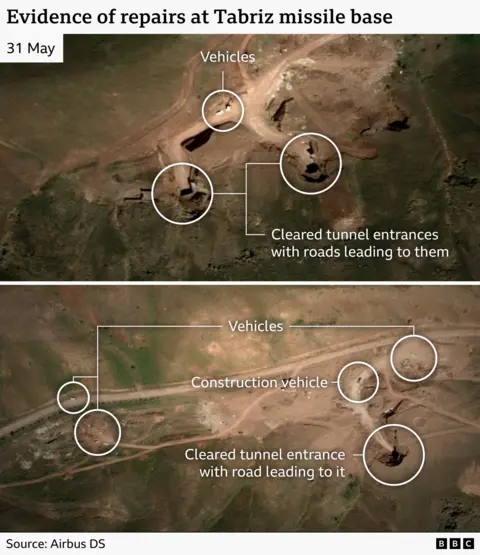
But despite the attacks seen to Iran's bases across the country, some of the images reviewed by BBC Verify appear to show that Tehran has been using the fragile ceasefire to conduct repairs to tunnel entrances at some key missile sites.
Throughout the conflict it has been difficult to determine the scale of damage to Iranian military bases as the US has sought to limit satellite coverage of the region. The Pentagon asked Planet, a major provider, to restrict new images of Iran and most of the Middle East in March. The company justified the move, saying that it wanted to ensure its images were not used "by adversarial actors to target allied and Nato-partner personnel and civilians".
However, BBC Verify used older Planet images and alternative international providers to record damage at 51 military sites across Iran, including air bases, naval facilities and IRGC compounds.
The analysis is a likely only a partial assessment due to the secretive nature of many Iranian facilities. The private intelligence company Janes estimated that there are a total of 197 military and IRGC bases in Iran.
Satellite images show that runways and aircraft have been hit at more than a dozen locations, which experts say has helped to give the US complete control over Iranian airspace.
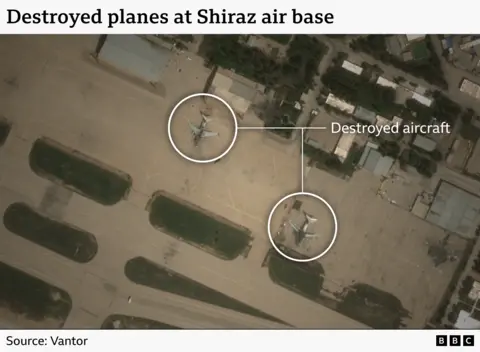
At Mehrabad International Airport strikes on 7 March destroyed at least 17 aircraft in the military section of the facility, while at Shiraz Airbase US-Israeli attacks between 2-17 April hit at least 13 planes.
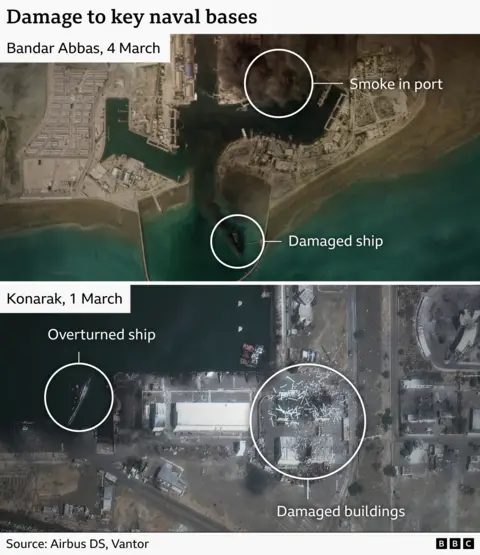
Strikes have also targeted Iran's fleet of warships. Multiple vessels and buildings were damaged during attacks on the Bandar Abbas Naval Base - the headquarters of the navy - in the opening days of the war.
Satellite images showed smoke billowing from a damaged ship and the administrative section of the port on 4 March, while multiple ships were also heavily damaged at Konarak naval base.
Meanwhile, satellite images appear to show extensive damage to the IRGC's naval headquarters and its general headquarters in the eastern suburbs of Tehran. The naval force's commander, Gen Alireza Tangsiri, was also killed in an Israeli operation in late March.
Experts told BBC Verify that despite the extreme blows suffered by Iran's navy and air force in these repeated attacks, Tehran still has the capacity to damage the US and its regional allies.
"Iran's ability to defend itself stems less from its conventional forces, such as its air force, than from its capacity to conduct counterstrikes via missiles or drones," said Zev Faintuch from the security firm Global Guardian.
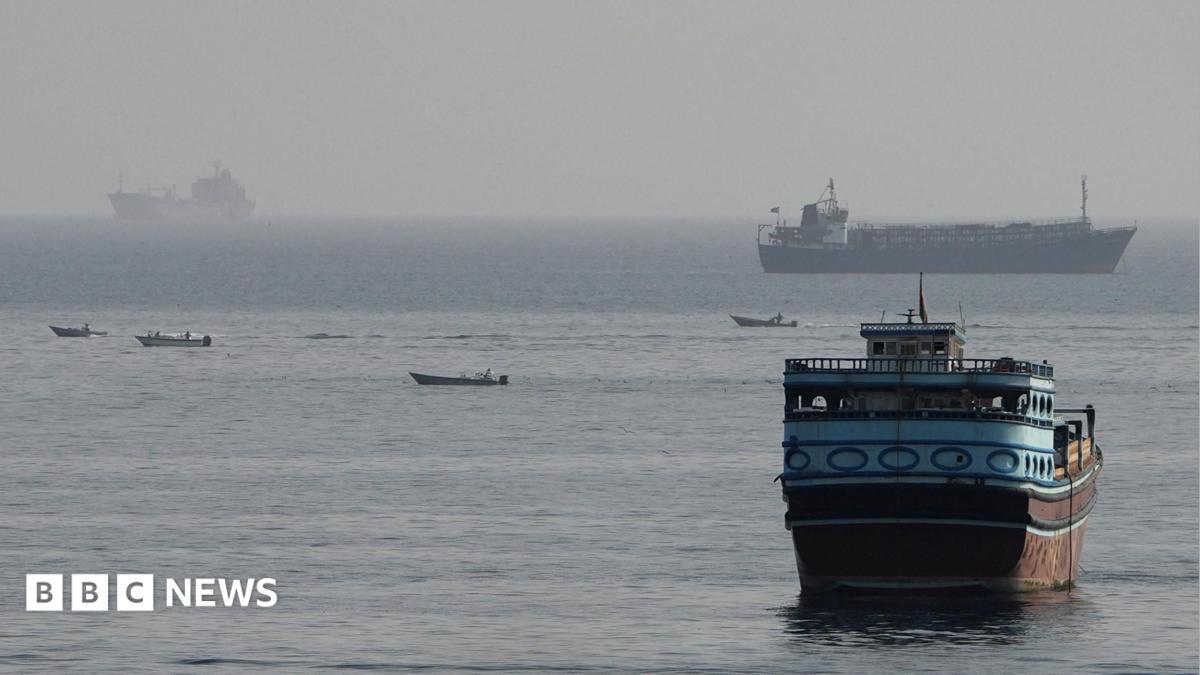
Raphael Cohen, Director of the National Security Program at the RAND School of Public Policy, said that Iran's "mosquito fleet" of small, fast vessels will allow it to continue to pose a threat to US forces and commercial shipping in the Strait of Hormuz.
Tehran also appears to be using the fragile ceasefire to conduct repairs to at least four of its ballistic missile bases, satellite images show.
Photos appear to show that roads have been cleared of debris at Tabriz missile base. Tunnels which were damaged by US-Israeli strikes appear to have been excavated and what look like construction vehicles and heavy machinery are visible in the images.
But Kamran Bokhari, senior fellow at the Middle East Policy Council, said Iran's economic struggles, which predate the war, could hamper efforts to fully rebuild military capability.
"Iran will be constrained by the amount of resources that they can deploy to rebuilding, because they will also have to address basic economic conditions."
In addition to military bases, many civilian buildings have been hit across the country. According to the US-based Human Rights Activists News Agency (HRANA), more than 1,700 civilians have been killed since the conflict began. However, Adm Brad Cooper - the US military officer overseeing the war - has challenged the suggestion that there have been thousands of civilian deaths.
US attacks also targeted internal security forces loyal to the clerical government, inclusing the IRGC compounds and bases belonging to the Basij paramilitary - a volunteer force controlled by the IRGC and often deployed on the streets to suppress dissent.
Satellite images show that its command centre in Tehran was damaged by a strike around 4 March, with an adjacent building entirely levelled by the attack.
At the outset of the war, President Trump hinted that one of his goals was to enable anti-government protesters to overthrow the clerical regime - though this has since been downplayed.
"These attacks were therefore almost certainly primarily aimed at increasing the likelihood of bringing about the conditions for regime overthrow which was an Israeli, and to a lesser extent, US goal," Lewis Smart, a principal analyst with Janes said.
"Such a move would be necessary to help aid any government overthrow from below and comes off the back of the December 2025 - January 2026 protests and riots that were brutally suppressed by Iran's internal security forces."
Additional reporting by Barbara Metzler.