.png)
 1 month ago
88
1 month ago
88
Iraq’s journey to their first World Cup in 40 years involved sacrifices unmatched by any other side. After 20 qualifiers, the team faced a decisive playoff in the Mexican city of Monterrey but, with Iraq dragged into the Middle East war and airspace closed, several staff and players had an arduous job getting there.
“They had to travel from different cities to Baghdad by car or bus,” says René Meulensteen, the assistant to Iraq’s coach, Graham Arnold. “Some of those journeys took up to eight hours. Then, from Baghdad they travelled roughly 15 hours on bumpy roads to Amman, in Jordan, where occasional flights were still operating. The other Asian-based players made their own way to Amman, so they could all travel together.”
Fifa had arranged a private charter, but the squad faced a nine-hour delay. An eight-hour flight to Lisbon followed, then a two-hour stopover, before a 12-hour journey to Mexico.
It was hardly ideal preparation for what Meulensteen, a former Manchester United coach under Alex Ferguson, describes as “the most important game in their lives”. But the team arrived with time for recovery and beat Bolivia 2-1 to secure the tournament’s final spot in front of a crowd that featured plenty of support for Iraq.
“All the remaining tickets were given to local Mexicans, so they were there in a big number, together with a large group of Iraqis based in the US,” Meulensteen says.
The location provided a full-circle moment. “We told the players: ‘Let’s realise what kind of journey we’ve had to get here and perhaps the match is meant to be here, as Iraq’s previous World Cup participation was staged in Mexico.’”
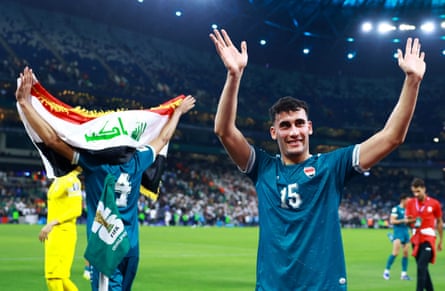
Back home, the scenes were electric. “It was absolute madness in Baghdad, where it was early in the morning,” says Meulensteen, who was shown videos of celebrations. “The whole nation has been craving something to celebrate and this gives people a huge boost of energy and hope. You can really feel the sense of pride; there’s a genuine feelgood factor.”
Qualification adds to achievements such as fourth place at the 2004 Olympics, where they beat Cristiano Ronaldo’s Portugal, and winning the 2007 Asian Cup. That triumph briefly united a country gripped by civil war and the 1986 World Cup and 2004 milestones also came against a backdrop of conflict.
“Iraq is still a country that is really feeling the aftereffects of the second Gulf war,” says Meulensteen. “You can see that in the cities. They are recovering, but logistically and organisationally you can’t compare it to Dubai or places in Saudi Arabia.”
Meulensteen, 62, enjoys the culture and the squad. “You should hear them on the bus to training and matches, singing and listening to music. It’s absolutely brilliant.”
Iraq have been drawn in arguably the toughest group, with France, Senegal and Norway. “It’s like Manchester United against Grimsby,” says Meulensteen, but the minnows won that tie last August and the Dutchman too intends to defy the odds, just as he and Arnold did with Australia at the last World Cup.
“We had France, Denmark and Tunisia in our group and weren’t given much chance of going through either,” he says. “But that’s where our biggest strength lies: the element of surprise.” Australia beat Denmark and Tunisia and gave the eventual winners, Argentina, a tough game in the last 16.
Iraq’s squad is made up of players born there and others with Iraqi heritage. Not all speak Arabic, but Meulensteen has an intermediate level after his early coaching years in Qatar. To make that move in 1993, he had to marry his girlfriend, because living together out of wedlock was not allowed.
Meulensteen arrived at United eight years later via the academy director, Lee Kershaw, and a recommendation from Dave Mackay, who had met Meulensteen while managing Qatar’s under-17s. Meulensteen started in the academy before taking on individual work with first-team players. That role intensified in 2007 after a brief spell as Brøndby’s head coach and he worked closely with Ronaldo. “I had several sessions with him on and off the pitch, using videos to show certain things. We focused on the key aspects of finishing, dividing the penalty area into zones to make him aware of his positioning, the type of crosses coming in and the best finish for each situation.”
Meulensteen more generally encouraged Ronaldo to focus less on flair and more on efficiency. “I told him it’s all about being as unpredictable as possible, varying your game … Over the years, he mastered that perfectly.
“What really stood out with Cristiano was his drive for perfection. And that’s still the case. At Carrington, we had this fenced cage with rebound boards. After training he would often go in there by himself for another 10 or 15 minutes. I also showed him exercises using those boards to handle the ball in different creative ways. He absolutely loved that.
“All the work we did that season – on the pitch and everything we discussed – I eventually compiled into a DVD for him. It was basically a PowerPoint presentation with video clips, in which I also explained the importance of setting goals, how people with clear targets are far more successful than those without them.”
At the start of 2007-08, Meulensteen asked Ronaldo what his target was for the season after scoring 23 goals the previous season. Ronaldo answered 30. “What about 40?” Meulensteen replied. Ronaldo agreed and scored 42 as United won the Premier League and Champions League.
In the summer of 2008, Meulensteen was promoted to first-team coach and entrusted with designing and leading training. “Sir Alex basically explained to me on three flipchart sheets how he believed Manchester United should play. And that became the navigation system for designing all the training sessions.
“It covered principles both defensively and in possession. But the final sheet, he said, was the most important, as it defined Manchester United the most. He said: ‘When we attack, I want to do so with pace, power, penetration and unpredictability. And I want you to apply those four things in every training session in some way.’ When you look back, during the period when we were at our best, you could see all those elements.”
After leaving United in 2013, Meulensteen’s work included a spell at Fulham and time in the US, Israel and India before he helped Australia to the World Cup. He gained invaluable experience that has proved useful in his work as a coach, including in helping players cope with doubts.
“If they experience fear, I ask them to give it a shape. What exactly is that fear? It could be the fear of the consequences of not winning a match. You don’t always have control over everything that comes into your head, like what you see and what you hear. But I encourage them to focus on what they want, their desires – like playing well, scoring a goal or reaching the World Cup.”
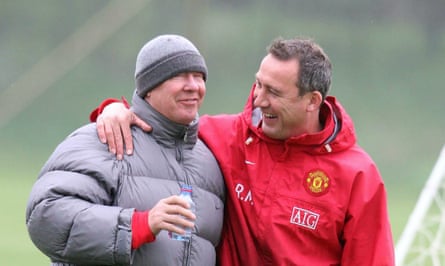
When working with players, he asks them to “add” things to their game rather than change anything. Ferguson also attached great importance to the impact of words. “He always said the two most important coaching words are: well done,” says Meulensteen. When training sessions were nearing their end, Ferguson would often walk past, tap Meulensteen on the shoulder and offer that very compliment.

The two developed a strong bond. “He is a great storyteller and has very broad interests. He reads a lot and knows a great deal about politics and history. He is absolutely fascinated by the American civil war; he knows so much about it. But also about movies, actors and actresses, you name it. He was incredibly well rounded.
“At United, when we were on the bus or train to away games, we would often play Who Wants to Be a Millionaire? on my iPad. The number of times we made it to the end is unbelievable. He knew things I would have never known.”
Every now and then they meet up for a cup of tea. “We’ll sit there for an hour and a half, two hours, and the time just flies by. It’s fantastic.” United, Meulensteen says, provided a “beautiful period” of his life. He hopes to add another this summer.