.png)
 1 month ago
60
1 month ago
60
“Tennis is in a good place, but I think it could be better,” says Tim Henman when asked about the state of the sport that has consumed most of his life. He will soon outline ways tennis could be improved but, first, it helps to remember that the 51-year-old played in six grand slam semi-finals, including four at Wimbledon, won an Olympic silver medal and became No 4 in the world despite constant gripes from part-time tennis supporters who wrongly said he lacked the grit of an elite player.
Yet grit filters through Henman’s memories and explains why he loves tennis while always striving to reach a better place. We meet at the Queen’s Club and the elegance of the venue provides a stark contrast to the series of cheap B&Bs where Henman lived, down the road in Earl’s Court, for two years at the outset of his career. Money was tight then and sometimes four young players could share a single room.
“I somehow convinced my parents that I should leave school at 16 to play full-time tennis,” he says. “I was still very small so my results weren’t particularly good. We were based in a far corner at Queen’s with the two indoor courts. It was such a basic facility, but it was brilliant.”
Henman grins when I ask him about B&B life. “Amazing,” he says. “So good. Funnily enough I bumped into Andrew Richardson just before I walked in to see you.”
Emma Raducanu’s coach helped her reach the final at the Queen’s Club last Sunday. Richardson also guided the 18-year-old Raducanu to her astonishing grand slam victory as a qualifier at the US Open in September 2021. That same month she decided to fire him as her coach before rehiring him this summer.
Henman nods when I ask if he shared a room with Richardson in Earl’s Court? “Absolutely. We first met when we were 11 and played against each other. Andrew was best man at my wedding.”
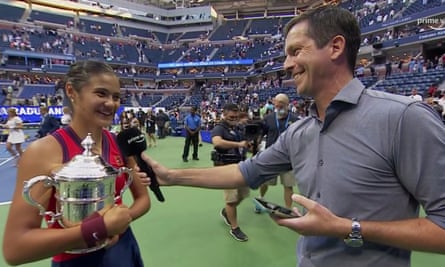
Henman was close to Raducanu during her unforgettable US Open run. Coaching was not allowed from the players’ box then and so Henman encouraged and advised her at courtside, where he was working as a television pundit. When she clinched the title the first person she turned to was Henman, who pointed back at her in delight. So he offers a unique perspective on her relationship with Richardson.
What did he think when, two weeks after she won what is, to date, her solitary adult title, Raducanu removed Richardson as she said he was not experienced enough? “I was surprised she chose not to work with him. She’s worked with a lot of coaches since then and now I really hope that her decision to get back with Andrew works for both their sakes.
“He’s one of my best friends and I’ve also been around Emma. So it would be good if results improve.”
Raducanu and Richardson have made headway and in the Queen’s Club final she lost to Donna Vekic. The winner acknowledged Raducanu’s resurgence after a difficult year, but Vekic reserved most praise for David Felgate – whom she restored to her own team a few weeks ago. Vekic said the victory at Queen’s, where she scraped into the main draw as a lucky loser, was shaped by Felgate’s expertise.
Felgate was one of three coaches Henman used during his career. “Emma’s had eight or nine coaches,” Henman says, “but it’s her prerogative. I looked for consistency, continuity and building the relationship – and that’s why I had three coaches in 16 years.”
Raducanu won the grand slam title that eluded Henman, but she has a long way to go before she matches the depth of his overall achievements. The way he had to fight for his spot on tour forged a resilience and steeliness in him. Does he believe Raducanu’s shock US Open victory damaged her development?
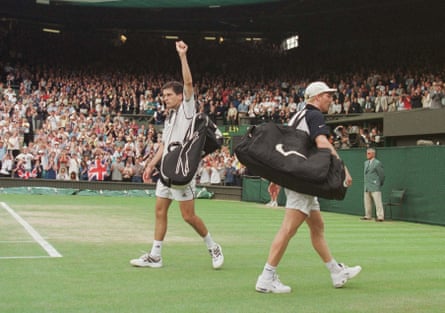
“It was so unexpected because no one had ever qualified and made the final of a slam, let alone qualified and won it. So she didn’t really have a foundation to build from. She’d just done her A-levels and played some grass-court tournaments and then her ranking went up to No 20 in the world.
“All of a sudden she was playing top-level events and she wasn’t ready, physically and mentally. You can’t drop down to build match practice and resilience but would you rather it had not happened? Absolutely not. It’s one of the most incredible achievements in sport.”
Henman is cautious when asked whether she can win another slam. “It would be very hard. Not many people win slams so you could say, if you’ve done it once, you can do it again. But it’s all about the process. She’s got to become physically more resilient to build up her schedule, her match count, her weight of shot, her speed of movement and durability.”
Is Richardson the right coach to unearth that consistency and durability? “Of course. He was a good player and he understands the game well. He’s got a good history with Emma as they’ve known each other since she was in her early teens.”
Even more than Raducanu, Jack Draper has struggled physically and the most talented British men’s tennis player on tour has missed most of the last year through injury. Does Henman expect that Draper, who reached No 4 in the world 15 months ago, will play at Wimbledon?
“I don’t know. He’s pulled out of Queen’s [this week] but this time last year he was in that conversation as to who might challenge Jannik Sinner and Carlos Alcaraz. He’s had such a rotten time because he was playing great tennis.
“It’s very challenging whether it’s this bone bruising or his knee. He’s just got to try and stay patient because, if you’re not healthy, you can’t compete.”
Henman expresses his misgivings in regard to the brutal calendar that has resulted in the injury of so many leading players. Alcaraz has been forced to miss the French Open and Wimbledon. And, after racking up a 30-match winning streak, Sinner’s body betrayed him during the first week in Paris. Leading Juan Manuel Cerúndolo 6-3, 6-2, 5-1, he lost 18 of the next 20 games to crash out in the second round. Sinner looked as if he had hit a wall after winning successive Masters tournaments in Madrid and Rome.
“The schedule needs looking at because less is more and I would definitely streamline it,” Henman says. “The Masters 1000 events should be eight or nine days and then you need some periods where there is no tennis at the very highest level. It’s good for the players and fans and builds expectation for the next event.
“I’m not a fan of the 12-day Masters 1000 events. Physically and psychologically that is tiring and, if anything, we should be trying to shorten the season.”
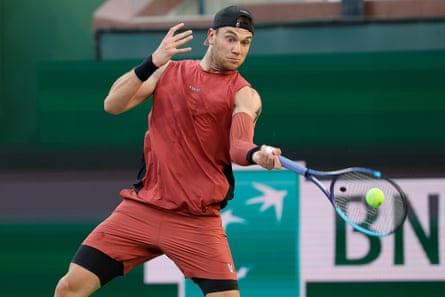
Money drives modern sport and so is it feasible that some tournaments could be curtailed or even cut? “It’s difficult, but that’s where the sport needs to come together. When you look at the governance of tennis there are seven different bodies – the ATP, WTA, ITF and the four grand slams. And right now we have this PTPA lawsuit.” The Professional Tennis Players Association triggered legal action against those seven organisations while accusing them of collaborating to reduce prize money, impose a restrictive ranking system and repress players’ promotional opportunities. “We really need to communicate, and that has made it very difficult with the lawyers.”
Henman has recently been at the heart of tense negotiations between the leading players and the grand slam tournaments over prize money. He is a board member at Wimbledon, but his achievements in the game mean Henman is respected by the players and last week there was a breakthrough. Wimbledon announced a 20% increase in prize money, which the players accepted, but has the situation been fully resolved?
“The communication needs to be better and conversations are not going to stop. It’s a huge strength of our sport that we have combined [men’s and women’s] events and look at how the grand slams have led the way in equal prize money and the opportunity that they’ve given to lower-ranked players. In the women’s game, the Wimbledon prize money for qualifying this year will be more than some of the [WTA] Masters 1000 events.”
Henman is particularly animated when confirming his reappointment as the vice-captain of Team Europe in the Laver Cup against Team World at the O2 in London in September. He believes the competition, which began in 2017, has the potential to become as powerful in tennis as the Ryder Cup is in golf.
“I absolutely love it,” Henman says. “Until I first experienced the Laver Cup in person I’d thought it was an exhibition event. But when I was at the 2022 Laver Cup, when Roger Federer played his final match before retirement at the O2, I was blown away by the intensity and passion of both teams.
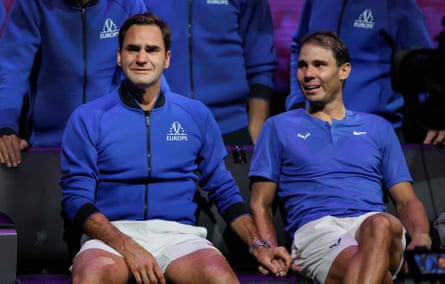
“The players are individuals and rivals and here they are coming together for the greater good of Europe or the rest of the world. The way the event was delivered was incredible and so when I was asked last year if I’d like to be vice-captain I was blindsided. But I felt it was an absolute privilege and I could not have enjoyed it more in San Francisco – apart from the fact that we didn’t win.”
Team Europe has won five of the eight Laver Cups and Alcaraz and Alexander Zverev, the new French Open champion, have agreed to play at the O2. “We were bitterly disappointed when we lost last time but it was then that Alcaraz signed up. He said: ‘I’m coming back.’ If the players love the event they have that intensity to win.”
Will Alcaraz be fit again by September? “I have no idea. It’s obviously a serious injury, because he pulled out of Madrid, Rome, Paris, Queen’s and Wimbledon. So, fingers crossed.”
Negotiations to entice Sinner to make his Laver Cup debut are under way and Henman says: “We have a WhatsApp group so we’re always in dialogue, looking at how the team could shape up.”
It seems a long time since, at the end of 1992, Henman was 18 and finally left B&B life in Earl’s Court. “I got my first ranking points in Morocco and central Africa. I had seven points and my ranking was 780 at the end of the year. That was such a defining moment, because I was on the ladder. I wanted to be 700. I wanted to be 500. I wanted to be 300.”
Henman smiles when I ask if he believed then that, one day, he would become the fourth‑best player in the world with an enduring influence in tennis in the decades ahead?
“No chance. If you’d said to me then: ‘Sign this document and you can be top 100 for the next 10 years, and play the grand slams,’ I would have bitten both arms off. It’s what I always wanted to do.”
The Laver Cup is at the O2 from 25-27 September. Visit lavercup.com.