.png)
 2 hours ago
2
2 hours ago
2
After watching 120 minutes of football, you might not find observing a coin toss the most exciting dessert. Fans in the stadium care, though. Win a coin toss for a penalty shootout and you choose the end where they are taken – to much rejoicing from those behind the chosen goal. Another coin toss also allows the winner to choose whether to go first or second. But does that decision actually matter?
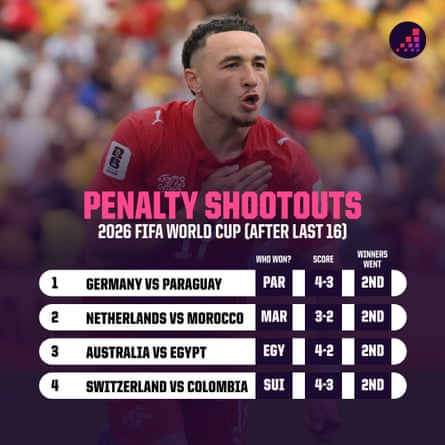
For years, the consensus was that going first in a shootout gives teams an advantage. Being able to take the lead and put scoreboard pressure on opponents surely has a mental benefit, and means they are more likely to face the dreaded “must-score” penalty. However, when Rubén Vargas tucked away the winning spot kick for Switzerland against Colombia in their last-16 tie, it continued a rather curious trend.
All four penalty shootouts at this World Cup have been won by the team that went second. That is not much of a sample, but 13 of the past 15 shootouts at World Cups have been won by the team going second (86.7%). The only shootouts in that time where the teams going first won were in the 2022 World Cup, when Morocco eliminated Spain in the last-16 stage and Croatia beat Brazil in the quarter-finals.
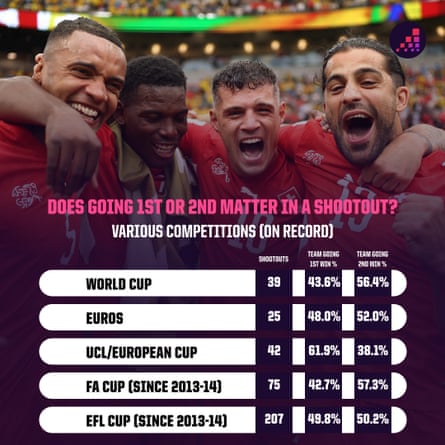
Is this just a statistical quirk, though, or are teams getting a genuine advantage by going second? Before the 2026 World Cup, 18 of the 35 penalty shootouts (51.4%) to take place in the competition had been won by the team going second, so almost an exact 50-50 split, suggesting no advantage whatsoever. With the most recent four, that has gone up to 22 of 39 (56.4%), so it’s only really the recent shootouts that suggest going second is best.
Indeed, before the past 15 shootouts, only nine of the first 24 World Cup shootouts were won by the team going second (37.5%), so perhaps that’s where the belief that going first was better came from. Again, though, that still isn’t really a big enough data sample. We need to look at other competitions.
The first penalty shootout at the European Championship was in 1976 between Czechoslovakia and West Germany, the famous shootout where Antonin Panenka dinked in the winning penalty. In total, there have been 25 penalty shootouts in the Euros, of which 12 have been won by the team going second (48%), so basically no difference.
There are more shootouts in club football, but what does the data say there? In the history of the European Cup, there have been 42 shootouts (not including qualifiers). In that competition, there does seem to be an advantage to going first, with only 16 teams winning when taking second (38.1%). Of course, in the most recent example, Paris Saint-Germain beat Arsenal in the final when they went first in the shootout.
That percentage doesn’t extend to other competitions, though. There have been 75 penalty shootouts in the FA Cup since the start of the 2013-14 season. Forty-three of them (57.3%) have been won by the team going second. Notably, though, given the trend at the World Cup, there has also been more of a tilt towards teams taking the second penalty recently. Last season, there were 17 shootouts in the FA Cup, 12 of which were won by the team going second (70.6%).
There have been 211 penalty shootouts in the League Cup since the start of the 2013-14 season. Four of those from the 2017-18 season were in the ABBA format, where the team that went second also went third, then the team that had the first penalty would also have the fourth and fifth, and so on. Funnily enough, that format was trialled due to a belief that going first was too much of an advantage, but we won’t count those here.
Remarkably, across the 207 League Cup penalty shootouts we looked at, 104 were won by the team going second (50.2%). So, the competition with the most data available ended up having the closest return of 50-50 of all of them.
What can we glean from all this, then? While there is something to be said for striking first, having the opportunity to go 1-0 up and immediately put pressure on the opposition, it can also backfire. In seven of the past 15 World Cup shootouts, the first kick has been missed, giving an immediate boost to the team going second. On each occasion, the team going second has won.
Indeed, of the 12 instances of a team taking the first penalty in a World Cup shootout and missing it, only two have recovered to win – Sweden against Romania in 1994 and Ukraine against Switzerland in 2006.
There could be a bit of confirmation bias/placebo effect at play, where teams are aware that going second seems to be an advantage, and just by thinking that, it calms them in a nervy situation, therefore making it likelier they can win even if really there is no solid proof it is actually any advantage whatsoever.
That being said, it is notable that of the four shootouts at this World Cup, in only one – Egypt’s win against Australia – did the team that won the toss choose to go second. So apart from perhaps Mohamed Salah, there are no other suggestions that teams have noticed the pattern and are electing to take the second penalty. Three out of four captains still wanted to go first, and none of those three ended up on the winning side.

Ultimately, and we hope this conclusion is not too disappointing, we can probably surmise that it doesn’t really matter whether a team goes first or second. The data broadly points to it being close enough to 50-50 across a long period that the quality of your penalty takers and goalkeeper are probably much more important.
It will be interesting to see if the trend at this World Cup continues, and how unsure captains look when the coin is flipped by the referee. First or second, the most important thing is that you just score as many penalties as possible and hope that it’s enough.
This is an article by Opta Analyst