.png)
 1 month ago
68
1 month ago
68
We are 365 days away from the 2027 Women’s World Cup, which will take place in eight Brazilian cities between 24 June and 25 July next year. This will be the third major women’s football tournament held in the country in the past two decades, after the 2007 Pan American Games and the 2016 Olympics in Rio de Janeiro, and preparations are in full swing.
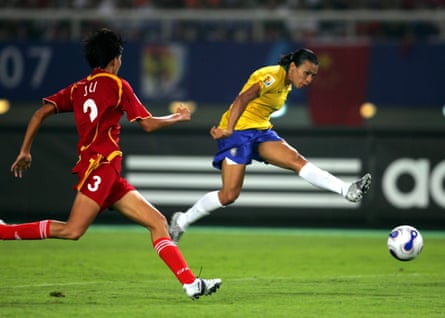
Playing captain in 2007, the former defender Aline Pellegrino was appointed as executive director of legacy and stakeholder affairs for the 2027 tournament and will lead efforts to build the future of the women’s game after the tournament. The World Cup final, to be played at the Maracanã, will coincide with the 20th anniversary of Brazil’s Pan American football gold.
“The mere fact that the Women’s World Cup is coming to Brazil for the first time represents, in itself, a legacy built by generations of women who were long rendered invisible,” Pellegrino tells Moving the Goalposts. She says her dream for the future of the women’s game in the country is that “the tournament will be remembered not only for the matches played but for the changes it has helped to bring about for future generations”.
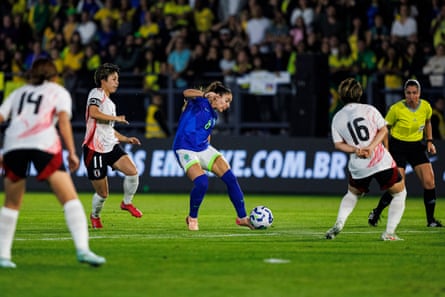
One of the current captains of the national team – a shared responsibility with players such as the legendary Marta – the midfielder Angelina Constantino was only seven at the time of the Pan American tournament. However, she knows she carries part of the history of the women’s national team with her whenever she puts on the iconic No 8 shirt, formerly worn by the Brazilian legend Formiga.
Having represented Brazil through the age groups, she has become a leader for the senior team and captained the side that beat Spain 4-2 to reach the Olympic final in Paris 2024. Constantino knows their performances on the pitch next year will represent much more for Brazilian women and girls than a football game.
“As soon as we step foot on the pitch for the opening match, we will need a lot of will power, a lot of grit, and love for that shirt,” she says. “Playing at home, having our families watching, the people we grew up with will be there … and beyond this dream, we know that we’ll be representing the whole country so I feel like it’s a great moment for the women’s game. The way that it’s been growing, we can use this special, historic moment for something bigger, to change the history of Brazilian football and how people see us.”
As the World Cup grows closer, the hope from former and current players is that the tournament will speed up processes that are already in place. Pellegrino and Constantino hope that the tournament will demonstrate the evolution of the women’s game throughout the country while they also dream of a first World Cup win for Brazil’s Women. They lost the 2007 final 2-0 to Germany in China. On home soil, however, they hope the fans’ support will be key, as it was 20 years ago at the Pan American Games, when Brazil beat the USA 5-0 at the Maracanã in front of a crowd of more than 70,000.
Pellegrino says that day was the most memorable of her playing career. “I was the captain and was at the front of the line. The feeling I experienced as I emerged from that tunnel and found myself in front of more than 70,000 Brazilians cheering on the women’s national team is indescribable. It was a unique, thrilling and unforgettable moment that will remain with me for ever.”
This month Brazilian women’s football fans had a little taster of what to expect in terms of the experience. The Seleção played two friendlies against the USA and broke attendance and viewership records. The first, played in São Paulo, drew 31,336 fans to the Neo Química Arena – even though the game was scheduled at the same time as a men’s national team friendly in preparation for their World Cup. The second, held at Arena Castelão in Fortaleza, attracted 55,744 supporters, setting a women’s football attendance record for the north-eastern region of the country.
“Every time we play in São Paulo, the fans show up and support us throughout the game. And for me it was really special to play in Fortaleza, because I didn’t know how many people were going to be there. I read somewhere that 68% of the 55,000 fans were women, so we see a different audience. That made me so happy; they were amazing, supporting us through everything. They applauded us, they loved the fact that we were there. It was definitely a little taste of what we can see next year.”
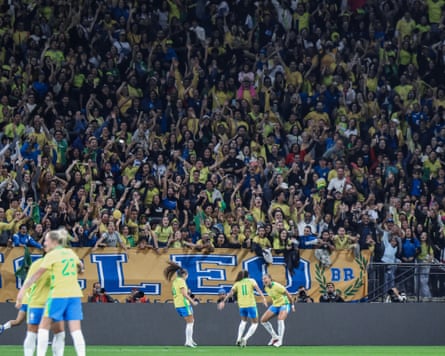
The fans caught the attention during the two matches. After losing 2-1 in São Paulo, the USA head coach, Emma Hayes, said she had “never heard anything like that before”, and that they should consider the environment a “mock” for what was to come next year. Brazil edged the first game 2-1 but USA regrouped and went on to win 1-0 three days later, in a tense game marked by the Brazilian team receiving eight red cards among players and members of the coaching staff, while six US players were shown yellow cards.
“Brazilians are really passionate, really intense,” says Constantino. “I imagine that, for the Americans, it was a cultural shock, because the energy at games here in the US is completely different. It’s a spectacle. For Brazilians, it’s all about the football so the fans put pressure on the opponents. They are our 12th player, and playing against us at home is hard. You can’t even hear yourselves on the pitch, there is a lot of noise, booing when they go for the ball, which helps us a lot.”
This is a key period. Pellegrino is working on a legacy off the pitch, developing strategies to support the women’s game, improve infrastructure and create social impact while Constantino focuses on her on-pitch efforts.
“Brazilian women’s football has a history marked by great struggle and resilience,” Pellegrino says. “It was built by women who dared to play football during periods when it was banned, and also in the years that followed, when they still faced many barriers. Listening to, valuing and honouring these stories is essential if we are to make historical amends.”
A lot has already been done. This month the Brazilian government took the first steps towards recognition for former players by introducing a Women’s World Cup Law – which, among other things, will financially compensate the pioneers of the national team for their services between the 1980s and 1990s.
This is an exciting time for women’s football in the country.
Get in touch
If you have any questions or comments about any of our newsletters please email [email protected].
-
This is an extract from our free email about women’s football, Moving the Goalposts. To get the full edition, visit this page and follow the instructions. Moving the Goalposts will be sent out once a week, on Wednesdays, in the close season but will be back on Tuesdays and Thursdays from September.