.png)
 1 month ago
35
1 month ago
35
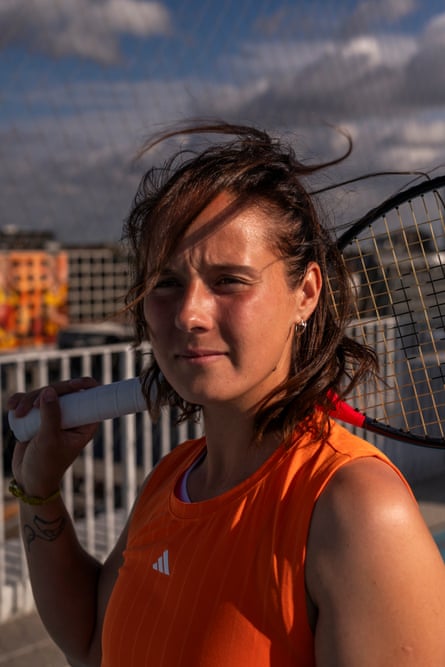
Daria Kasatkina wants Australia to call her something else. “I think ‘Dasha’ is better,” says the former Russian. “Daria is more like an official name which is written in my passport, so I prefer Dasha because it’s just less … formal.”
There has been upheaval in the life of the 28-year-old, much of it in the past 12 months. She became engaged to her partner, Natalia Zabiiako, a former elite figure skater, better known as Natasha. “It works the same way, like, with my name,” Kasatkina says.
Kasatkina pulled out of three major tournaments at the end of last year’s gruelling WTA Tour for the first time in her career, citing exhaustion. Though she made the round of 16 at Roland Garros on the clay she has traditionally preferred, as well as at Melbourne Park, her ranking slipped to its lowest in more than five years.
One change, however, is a source of optimism. Here, the more relaxed, laid-back ‘Dasha’ makes sense. “Because I became an Australian,” she says, “it has to be a bit more ‘chill’.”
Kasatkina became a permanent Australian resident in March, driven from Russia largely by the criminalisation, censorship, and violence faced by the LGBTQ+ community. She now has citizenship, and her new passport was – as of Saturday – waiting for her at the post office. But she is still getting used to the peculiarities of Australian life.
“Everyone is so chill, like ‘if you’re late, you’re late, mate’. It’s okay, take it easy, don’t worry about it. ‘You’re there, when you’re there’,” Kasatkina says, looking bemused. “In my culture it was a little bit different.”
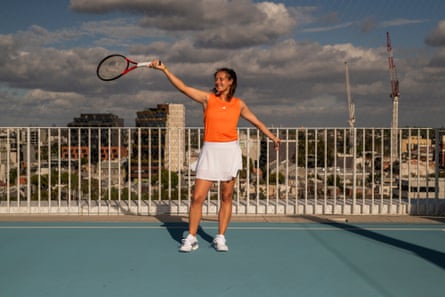
She is fresh from her citizenship ceremony, speaking at the inner city offices of Adidas, her longtime sponsors whose local arm is quietly elated at having such a widely loved player land in their lap before this year’s Australian Open.
Kasatkina faces Nikola Bartůňková, a fast-rising Czech teenager in the first round on Tuesday. In recent weeks, the former Russian has battled nerves of playing in front of home crowds in Brisbane and Adelaide, but showed – in a victory over Greek veteran Maria Sakkari – signs that she is returning to form.
“I felt this energy and I really liked it, so I’m really looking forward to playing in a ‘home slam’ – I can’t believe I’m saying that,” she says, shaking her head. “I see how people just love sports here, how they support their local players, athletes and for me that’s beautiful, this culture of sport since you’re growing up as a kid.”
She has previously described her on-court game as creative, using her brain and legs to outfox more powerful players. But she is not one to talk herself up. “Honestly, you just go and play,” she says. “There is not much I can say about my game, I just want people to come to my matches and enjoy.”
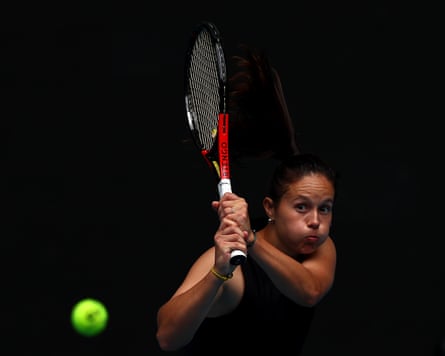
Italian coach Flavio Cipolla and Zabiiako have been joined in Kasatkina’s box by fitness coach Jona Segal, who has more than two decades of experience in AFL and tennis, in an addition made possible by the support of Tennis Australia. Since changing allegiances, she has also been invited to join the WhatsApp group that Australia’s top women’s players use to communicate, and provide emotional support.
Kasatkina was initially confused by the invitation, wondering what there would be to discuss. “But then I realised that the girls, whoever won, they just said like ‘good job girl, keep going’. And I’m like ‘oh OK, so that’s how it works’,” she says. “I wasn’t used to it as well, but I think this is nice, it’s this team spirit here, so you’re supporting each other, you’re happy. Like … you’re not jealous of the success of the other player.”
The regular YouTube videos Kasatkina and Zabiiako post about life on the tour provide insight into the dynamics between eastern European players. Kasatkina is close with Maria Timofeeva and Kamilla Rakhimova, former Russians who now play under the flag of Uzbekistan.
But the new Australian is also tight with those who retain ties to Russia, such as veteran Anastasia Pavlyuchenkova, who has condemned the invasion of Ukraine, and 18-year-old Mirra Andreeva, already a top 10 player and the country’s best prospect who has been lauded by Vladimir Putin.
“I have to actually find friends on tour because I’m the person who needs to talk, to share a little bit, and to have conversations with people,” Kasatkina says. “Of course there are some girls who have different opinions, so we are not engaging with them too much, but most of the girls are nice and funny, and they’ve got a lot of things to share.
“For me that’s amazing, because in the end we are like a circus travelling around the world, and we have to deal with each other every single day, we are with each other in locker rooms and the player restaurants and the lounges and the gyms and the tennis court. So, I mean, we have to get along with each other, and I’m fine with most of the girls.”
Despite feeling compelled to cut ties with Russia, Kasatkina speaks with fondness about some aspects of her homeland, where she still has family. “People with ‘Russian mentality’ are super responsible, it’s like, you can really rely on this person, ‘this person will do the job’ – this is one of the good parts,” she says. “Then, you know, Russians can be a bit grumpy, like with this ‘stone face’ and stuff. But honestly there are many good Russians in the world, and unfortunately now it doesn’t look like that but, I mean, it is. Honestly, it is.”
Kasatkina reached a career-high ranking of No 8 not long after making a grand slam semi-final, at the French Open in 2022. In that whirlwind year, she was critical of the Ukraine invasion and announced she was gay. Although she said in 2023 coming out was a pressure release, the relentless tour finally caught up with her in 2025. “I hit a wall”, she said in October when she ended her season early, citing mental and emotional exhaustion.
For the first three weeks of downtime, Kasatkina struggled. But her energy slowly returned, and studying for Australia’s citizenship test offered an outlet, a symbol of a fresh start. She aced it when she arrived in Australia in December. “Twenty questions, multiple choice, it was quite doable. But I was still very excited when I got 100%,” she says. “It’s like on a tennis court: you prepare, you train and then you’re showed the result and you’re happy, so you get rewarded.”
Kasatkina has developed a fondness for wombats, after meeting one during an Australian Open promotion, and she is familiar with koalas and kangaroos. But when shown an image of a platypus, known simply as “duck-nose” in Russian, she is stumped. “Plat-y-kus?,” she laughs.
Kasatkina is starting to embrace her Australian-ness in other ways, even if she has no plans to move here just yet. “I feel so comfortable, honestly. This is a place to live, a place to raise your kids,” she says, expressing gratitude to those who have assisted in her expedited citizenship process.
But for now, home will be the merry-go-round of hotel rooms, alongside Zabiiako. “Just to have the person you love next to you, it’s very important,” Kasatkina says. “It gives you the feeling of home actually, which most of the tennis players kind of miss during the year.”
And whatever happens on court at Melbourne Park in coming days, Kasatkina looks forward to returning. “I mean, honestly, it’s a beautiful country. I can talk about it for long,” she says. “The people who were born here, they’re just … I hope they realise how lucky they are.”