.png)
 1 month ago
60
1 month ago
60
Football is cyclical. Trends come and go. After the rise of inverted wingers, who tend to cut in and shoot, are we seeing the return of traditional wingers – those wide players who hug the touchline and send in crosses on their stronger foot?
We are seeing a lot of goals scored from deliveries into the box from out wide. In the first two rounds of games, 29 of the 48 teams at the tournament scored at least one goal within five seconds of a cross into the box.
In isolation, those figures won’t mean much, but 29 teams scoring within five seconds of any cross into the box is already five more than at any World Cup on record (since 1966). Obviously, not every tournament had as many as 29 countries participating, but the point stands: many teams have had joy in this manner.
The Netherlands are chief among them. They scored from crosses in both their first two games. There was Virgil van Dijk’s brilliant header from Ryan Gravenberch’s deep delivery against Japan. Then, in the hammering of Sweden, Brian Brobbey converted two low crosses and Cody Gakpo scored at the back post after being set up by Denzel Dumfries.

Portugal have also scored four goals within five seconds of a cross, with three coming against Uzbekistan – including Cristiano Ronaldo’s brilliantly taken first from João Cancelo’s low delivery.
Norway have also had some success this way, scoring three goals against Iraq from crosses. Their first in that game was the type of goal that has felt trendy at this World Cup: low and just behind the backline. Erling Haaland was the beneficiary, racing in to prod home at the back post.
That devilish pass into the “corridor of uncertainty” has been a feature. Lamine Yamal, Gakpo and Brobbey have scored goals from similar situations, and Mohamed Hany scored an own goal in the Belgium-Egypt match when Romelu Lukaku looked destined to turn in Thomas Meunier’s low cross.

How unusual is it to have so many goals from crosses? There are two ways of looking at this: goals from completed crosses (straight to a teammate), or goals within five seconds of any cross (rewarding teams for dangerous crosses that defenders may have got a touch on).
When it comes to goals from completed crosses, there were 36 in the first two rounds of games, which equates to a rate of 0.75 per game. Since records began in 1966, the only World Cup to see more goals from completed crosses per game was in 2002 – that tournament saw an average of 0.84; so, 2026 isn’t far behind.
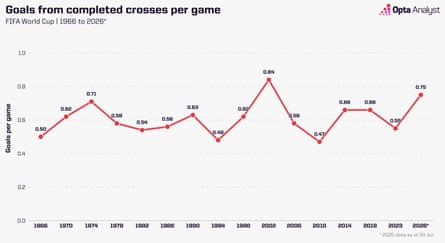
Only one other World Cup on record has surpassed 0.70 (1974 – 0.71). There were just 0.55 goals direct from crosses per game in Qatar, so we have seen a 36.4% increase in the past four years.
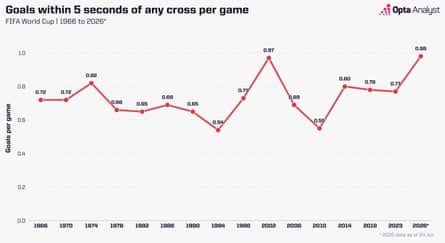
Now, what about goals within five seconds of crosses? Well, in the first 48 matches we had 47 goals within five seconds of crosses – that’s 0.98 per game. That is on course to be a record, as the previous highest was 0.97 in 2002; otherwise, only 2014 (0.80) and 1974 (0.82) have even reached 0.8 goals. Qatar 2022 came in at 0.77 per game.
Presumably this is due to teams putting in lots more crosses than before? Actually, no. Matches are averaging 31.5 crosses per game, which is comfortably the fewest on record. The standard of these crosses, or at least the likelihood that they lead to a goal, however, appears to be high.
The average expected assist (xA) value (the probability of the delivery directly yielding a goal) of completed crosses is 0.076; obviously that doesn’t sound extraordinary, but the previous highest for a full tournament is 0.068 xA in 2014. Essentially, crosses at this tournament are being played into dangerous positions more consistently than at any previous World Cup.
We can’t conclusively say the standard of crossing has been better than ever though, because attacking teams could be benefiting from the poor defensive positioning of their opponents. But, purely relative to historic data, the 2026 World Cup comes out on top.
This also isn’t far off being the case when we look at the proportion of crosses that find a teammate; at 24.1%, this tournament is marginally behind Italia 90 (24.38%) and the 1978 World Cup (24.19%).
Corners do play a part. As we know from the Premier League, set pieces have taken on more importance, and the average of 0.36 goals from corners per game at the 2026 World Cup is the third-highest frequency on record.
But it goes beyond just dead-ball situations. One potential explanation could be the use of technology. This is the first World Cup to use VAR and semi-automated offside tech; players can pretty much guarantee they will not be pulled up by an incorrect offside decision if they time their runs perfectly.
Another explanation is that teams are more deliberately looking to exploit gaps behind full-backs as a means to penetrate packed defences. It’s perfectly understandable that teams with less quality resort to sitting in a low block, and if their opponents are finding it difficult to carve through them, getting the ball into wide areas may be seen as a credible alternative.
Canada were a good example against nine-man Qatar; their 55 crosses in that match was the most in a World Cup game since Spain hit 57 crosses against Switzerland in 2010, and third most on record (since 1966). Qatar had the majority – if not all – of their players behind the ball for most of the match, so Canada shifted the ball wide to more readily test the heart of the Qatari backline. It worked well for them, yielding three goals either directly or indirectly. Qatar tried to frustrate Canada but they successfully found a way through – or should that be around? – them. Wing play was crucial to that.
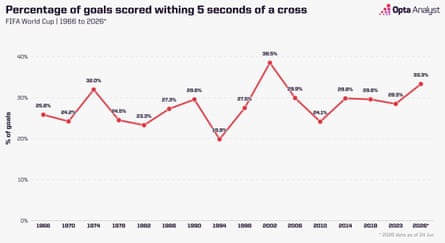
Furthermore, the proportion of goals scored at this World Cup that have come within five seconds of a cross is 33.3%; the only other World Cup on record to see a greater share of goals arrive in such circumstances was – you guessed it – in 2002 (38.5%).
But none of this is to say these bombardments always work. In fact, of the nine instances when a team has recorded 30+ crosses in a single game, Canada are the only team to actually win, and they were helped by Qatar having two men sent off.
So, presumably, variety is a factor, as well as being smart about when to shift possession out to wider spaces rather than doing so by default. It also obviously doesn’t hurt to have players capable of delivering pinpoint crosses or getting into decisive areas.
The number of goals being scored from crosses could still decrease considerably as the tournament progresses. When the poorer teams go home we see fewer low blocks and crosses might be deemed a less effective strategy. For now, we can cling to the slightest hint of “old-fashioned” nostalgia, though we need to see more evidence before we can truly declare that classic wing play is back.
This is an article by Opta Analyst