.png)
 5 hours ago
1
5 hours ago
1
Jonathan BealeDefence correspondent

 EPA
EPA
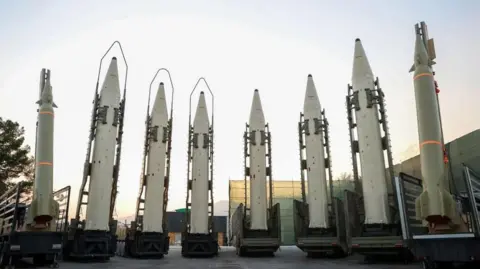
Before the US-Israeli attacks, Iranian officials had displayed their missiles in a show of defiance
Iranian missiles have tried to target the joint US-UK military base in Diego Garcia in the Indian Ocean.
Two missiles were launched last Friday - one failed and one was shot down, UK Defence Secretary John Healey says.
Diego Garcia is nearly 4,000km (2,500 miles) from Iran and the Iranian attempt has raised alarms about the range of the country's missiles and fuelled fears that Iran could now also target much of Europe, even London.
There are still doubts about the capability of Iranian missiles to reach targets so far away. But the one which failed last Friday managed to travel some 3,000km from its launching base.
So how serious is this Iranian threat?
West has eyes on missile paths
The US and the UK will have had clear indications that Iran was trying to target Diego Garcia. They would have been watching the missiles in flight.
The US Space Force is able to detect every missile launched from Iran from Buckley Space Force Base in Colorado. Last year the BBC was given rare access to film inside the control centre where they can watch the trajectory of any missile fired across the globe.
They use a constellation of satellites from space and powerful radars on the ground - including at RAF Fylingdales in the UK - which can track the missile from launch to target.
Does Iran have a longer-range missile capability?
The launch, however unsuccessful, suggests that Iran has not been transparent about its missile programme.
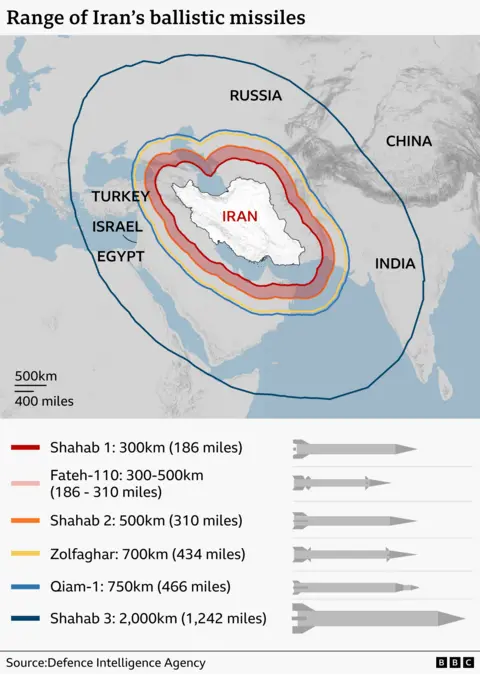
Tehran has previously stated it had unilaterally limited the range of its missiles to 2,000km. But Israel now claims that Iranian missiles have double that range – up to 4,000km. That would put not just Diego Garcia in its sights, but also much of mainland Europe.
Despite its own claims, Iran has long been known to have short-range ballistic missiles - with a maximum range of 3,000km. It is what they have been firing frequently at Israel and neighbouring Gulf nations over the past three weeks.
Before the war, Iran was believed to have had stockpiles of more than 2,000 short-range ballistic missiles. Despite the US and Israel targeting these munitions, they are still being launched.
Less clear is Iran's intermediate-range ballistic missile programme - with a range of between 3,000km to 5,500km.
Sidharth Kaushal, a senior fellow at London-based think tank the Royal United Services Institute (Rusi), says that it was "long understood the Iranians had an Intermediate Range Ballistic Missile programme before this war started".
He explained that assumption on the basis of two possible reasons. First, longer-range missiles would be required if Iran wanted to develop a nuclear weapon - which it has persistently denied, despite Western accusations. The second is that Iran has needed to develop longer-range rockets for its own space programme.
What missiles did Iran fire at Diego Garcia?
It is still not clear what kind of missiles were fired at the US-UK base in the Indian Ocean.
Kaushal says it could have been a version of Iran's Khorramshah missile - which is based on a single-stage North Korean model.
That had a range of more than 2,000km with a 1.5 tonne warhead.
However, Kaushal says "you could very easily double that range by using a much lighter warhead", even though doing so would have probably caused limited damage to the base at Diego Garcia.
Kaushal also said it was possible that Iran has been adapting rockets from its space programme. After all, Tehran has successfully put satellites into space and rockets like the Qaem 100 "were always understood to have dual-use capabilities".
However, Iran is unlikely to have large numbers of intermediate or even long-range ballistic missiles.
The US and Israel already targeted Iran's ballistic missile programme last year when they sought to destroy its nuclear programme. What's left is now being hunted down.
The fact that Iran only fired two missiles towards Diego Garcia suggests its long-range missile capability is limited.
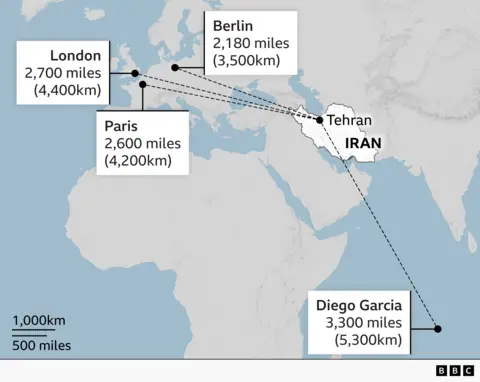
The distances Iranian missiles would have to cover
If Iran chose to target Europe, there are already some precautions in place to deal with the threat.
The US has long been concerned about the dangers of ballistic missiles being fired from the Middle East region.
Under President Barack Obama, the US set up ballistic missile defence systems in Poland and Romania - all part of a Nato air defence umbrella. These Aegis Ashore systems fire the same interceptor missiles currently being used by the US Navy to shoot down Iranian ballistic missiles.
Britain itself has very little in the way of ballistic missile defences - a glaring gap acknowledged in the government's recent Strategic Defence Review.
But, for now, the threat seems remote.
Kaushal says "it's conceivable" that an Iranian rocket "could reach London".
"Missile range is an elastic thing - in that if you put a lighter warhead on a missile, you can extend its range," he told the BBC.
This meant it was "not terribly surprising" that Iran could, in theory, reach the UK with its missiles, but "so what?"
These would be "a small number of conventionally-armed ballistic missiles over well-defended airspace... and they're quite inaccurate at very long ranges".
Research analyst Decker Eveleth of the CNA Corporation, a non-profit research and analysis organisation based in Washington DC, agreed.
There are "a lot of unknowns with the design", he told the BBC.
"When you increase the range, you're going much farther up into space, but that means you're also coming down a lot further… therefore your speed increases, you need to design better and better heat shields for your payload," he said.
He added that "as your travel time increases, you're going to get compounding errors in your guidance system… the inaccuracy of your missile is going to increase".
"It's true that a missile can reach London," he concluded, but added: "It is not going to be particularly aim-able."
"I would say the level of risk to London is pretty low," Eveleth concluded.
Justin Crump of intelligence company Sibylline said the key lesson from the attempted strike on Diego Garcia may not be about the capability of the missiles, but of the forces firing them.
"Iran is still able to surprise the US and Israel after three weeks of bombing. Their forces may be degraded, but they are not on the ropes," Crump told the BBC.
Additional reporting by Anna Lamche