.png)
 5 hours ago
4
5 hours ago
4
The Lucknow Super Giants kit says a lot about their team. Specifically, it draws from the “cultural fabric” of the city and the surrounding state of Uttar Pradesh, “where colour, craft and ritual shape everyday life”. According to the team website, the shirt-and-trousers combo signals “ambition grounded in responsibility to the city it represents”, and reflects “resilience under pressure, steady progress and the confidence that comes from building the right way”. It’s quite an achievement to weave that much subtext into a standard pattern of red-and-blue stripes.
Justin Langer, who coached the team through this season’s Indian Premier League, will have no doubt conveyed some of this messaging to the Manchester Super Giants, as the men’s squad pulled on the exact same colours (including the elephant on the club crest) before their Hundred debut at Lord’s. Or perhaps Aiden Markram – captain, now, of all three team Super Giant franchises – tugged at his shirt in his pre-match talk and evoked its reinterpreted, Mancunian significance. As per a slightly disastrous social media launch in June, the colours are now said to represent the perfect summertime union of the northern city’s warring footballing tribes.
Either way, that moisture-wicking premium-performance fabric is doing a lot of heavy lifting in the heritage department. But then, the Hundred has always been an experiment in manufactured identity. Five years ago, it detonated itself across August in a visceral explosion of clashing colour; a tournament backdrop of urgent pink-and-green strobing with the neon yellows, oranges and reds of its team designs. Back then, the purpose of this palette was anything but subtext. This was CRICKET IN CAPS LOCK, dazzling fluorescence to captivate the sport’s newborns, radioactive signals for a hyperactive audience.
As for history or past heroes, the Hundred had none. That absence is presumably part of the appeal for many of this year’s incoming investors – particularly IPL owners, who can overwrite their own backstory on to their purchased product. In that respect you have to feel sorry for the erstwhile Oval Invincibles, who had done such a good job of living up to their name in their short lifespan; their new title, courtesy of their partnership with Mumbai Indians, is now in continual dispute among commentary teams. Is it “My” London – as in not yours – or is it “M.I. London”, which makes it sound like a hyperlocal branch of the intelligence service, based just down the road from the Oval?
Perhaps this continued randomly generated feel to the teams is why the Hundred’s first week in its new privatised incarnation hasn’t yet felt radically different from what came before. The quality of the action has felt familiar, with a couple of disappointingly one-sided affairs, and a couple of properly exciting finishes. Some of the intrigue is sharpened by the fact that, since the move from draft to auction, we’re still trying to remember who plays for whom. When Joe Root walked out in red on Wednesday night, it took a beat to recall whether he was officially Welsh or Southern this year; it had been hard enough imagining the Yorkshiremanhim as Trentish.
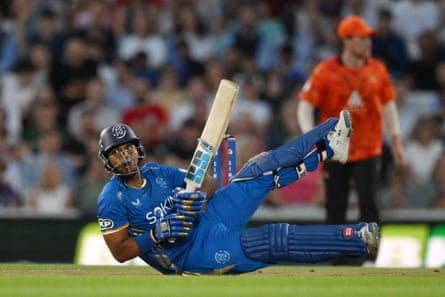
According to its original stated purpose, the tournament is clearly a success. Grounds are filling with happy families; the game of cricket is being beamed back into the mainstream consciousness. For those who remember the days of County Championship matches on terrestrial telly, it’s a genuine thrill to hit the remote and find cricket cutting a swathe in BBC Two’s schedule, even if the coverage retains the flavour of a six-hour long advert for … the Hundred. Players are earnestly described as “entertainers”, while hosts dive into the crowd to ask them what exactly they love about it (perhaps it’s secretly part of Romesh Ranganathan’s licence-fee campaign).
There are improvements, too. The live music has upgraded from Emerging Talent to Acts You’ll Remember From A Few Years Ago. Attendances have started strongly and viewing figures consistently suggest school-holiday scheduling is engaging kids, although the real proof of cut-through will be when James Vince gets a CBBC spin-off show, playing pranks on his former Southern Brave teammates, with guest appearances from Fury and Nitro.
Half a decade in, however, we’re still trying to work out what this thing actually is. How seriously are we meant to take the sporting action itself, when Jess Jonassen is commentating on her own bowling during her run-up? And rather than offering clarification, the arrival of private equity has raised more questions. What do those who have spent vast sums to co-own teams ultimately want from their investment? What does success look like for them? And how does that align with the goals of English cricket, be that the domestic structure outside the Hundred, or the best interests of the national teams?
Corporate soundbites are yet to reveal any satisfactory answers. With half the Hundred teams now affiliated to IPL franchises, we must assume that the tournament is increasingly concerned with an Indian audience, or at least a diasporic one. Most of the investors involved are playing a much larger game – call it Monopoly meets Risk – where they grow their brand across the multifarious franchise leagues in South Africa, the US, the Caribbean and beyond. English players aren’t the first to have to pretend loyalty to second-hand logos, or wear hand-me-down clothes.
after newsletter promotion
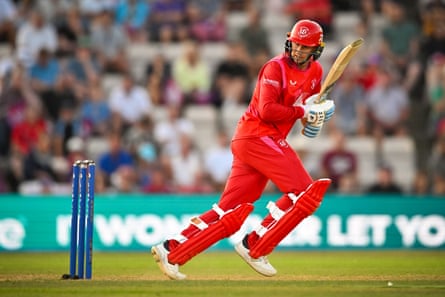
How long will it take for any of this shareholder-led vision to accrue meaning? There’s plenty of genuine, youthful fandom in the stands, wearing the merch and waving the sponsored placards. All leagues have to start somewhere, and this one has started in pushchairs and pigtails. Perhaps aligning with the IPL teams’ teenage growth spurt will emboss it with some of the identity it has lacked. Perhaps it will encourage more Asian families into the grounds. Perhaps the celebrity appeal of Indian billionaire owners will allow the community (or at least sections of it) to feel a wider sense of belonging in English cricket, at the elite level as well as the recreational one.
And perhaps this is all a bit of a reach. For now, it’s back to the Super Giants jersey, that material manifestation of the “deep emotional connection” that its global following has with a franchise only four years old. You can’t hurry history, but perhaps you can fake it: after all, MI London’s new shirt has the Oval Invincibles’ finger logo secreted in its background design, an Easter egg for the preteen ultras. As we evaluate the future, privatised Hundred, we should be measuring not just its child-friendly atmosphere and media-rights value, but its capacity to segue from cricket-related entertainment to a tournament with inherent sporting meaning.